
Why Did the IRS Reject My 501(c)(3) Application?
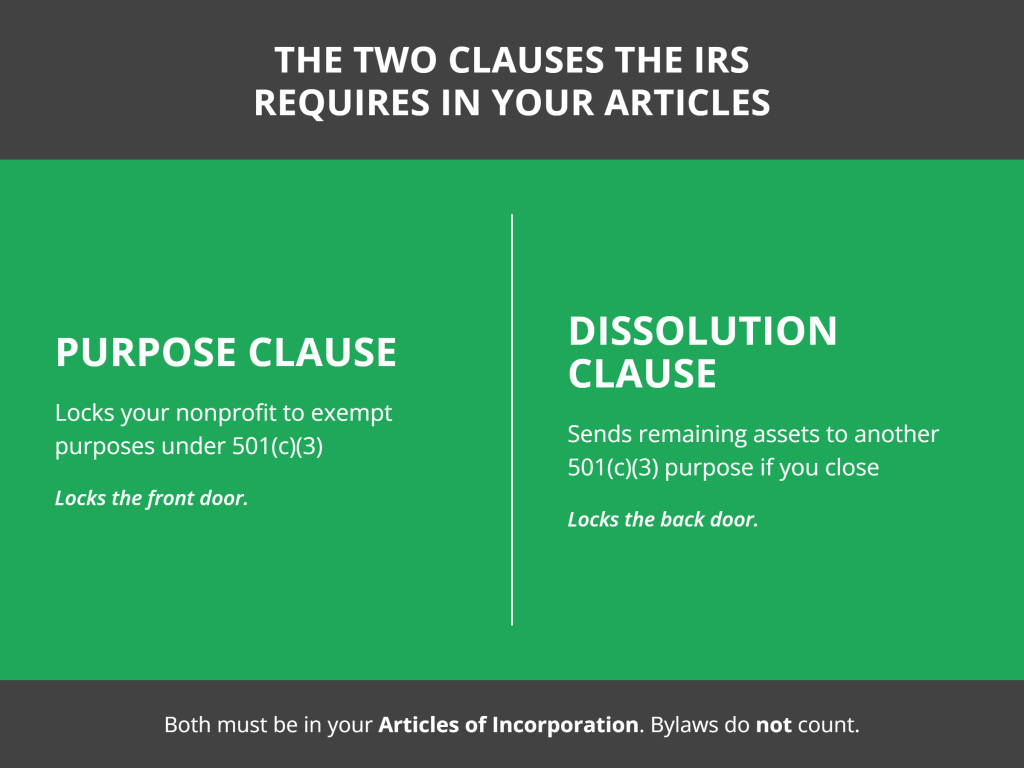
Why Did My Application Get Rejected? While there are several reasons the IRS rejects a 501(c)3 application, the most common reason is that your Articles of Incorporation fail what the IRS calls the organizational test. This is usually because they are missing a proper purpose clause, a dissolution clause, or both. The fix is to amend your Articles with your state, then respond to the IRS with both your original and amended Articles before your deadline. Most founders misdiagnose this. They assume the IRS decided their cause was not “charitable enough,” or they assume they are covered because the right language is in their bylaws. Neither is true. The IRS almost never rejects small nonprofits over their mission, and bylaws do not count. The trap is that this is a federal requirement hiding inside a state document, and your state will happily accept Articles of Incorporation that the IRS will later refuse. I file and launch nonprofits for a living at Next Level Nonprofits, and I have helped launch dozens of organizations over more than a decade in this sector. In the self-filed applications we review, approximately 75% have this exact problem: the required clauses are missing from the Articles entirely, or they were placed in the bylaws where the IRS will not accept them. Let’s walk through what went wrong and exactly how to fix it. First, Figure Out Which Kind of “No” You Got Not every bad letter from the IRS is a rejection. You are usually holding one of three things: A request for additional information. This is the most common. An IRS agent reviewed your Form 1023 and is giving you a chance to fix problems, including amending your Articles. This is good news. Respond completely, and by the deadline in the letter. A proposed adverse determination. This is an actual denial with appeal rights. You have a limited window to protest, so read the deadline carefully. A returned or closed application. If your application was incomplete or you did not respond in time, the IRS can close your case. To try again, you file a new application and pay the user fee again. The fee, currently $600 for Form 1023 and $275 for Form 1023-EZ, is nonrefundable, per the IRS. If your letter asks about your “organizing document,” “purpose clause,” or “dissolution provision,” you are in the exact situation this post solves. The Organizational Test, in Plain English To be recognized under Section 501(c)(3), your organizing document, which for a nonprofit corporation means your Articles of Incorporation, or in some states, your Certificate of Incorporation, must do two things, per the IRS: 1. Limit your purposes to exempt purposes. Your Articles must state that the corporation exists exclusively for one or more purposes described in Section 501(c)(3): charitable, religious, educational, scientific, and so on. A generic “any lawful purpose” clause, which many state templates and online formation services use by default, fails this test. 2. Permanently dedicate your assets to those purposes. If your nonprofit ever shuts down, the money and property left over must go to another 501(c)(3) purpose or to a government body. It cannot go to you, your board, or your members. Here is the WHY behind the rule. The IRS is not being picky for fun. Tax-exempt status is a deal: donors get deductions and you skip income tax because the assets are locked to a public purpose forever. The purpose clause locks the front door. The dissolution clause locks the back door. Without both clauses in writing, there is nothing legally stopping a founder from dissolving the nonprofit and pocketing everything, so the IRS refuses to sign the deal. The Two Clauses, With the Actual Language Do not paraphrase these. Use language modeled on what the IRS itself publishes in Publication 557’s suggested language. A purpose clause looks like this: The Corporation is organized exclusively for charitable, scientific, and educational purposes, pursuant to Section 501(c)(3) of the Internal Revenue Code of 1986, as amended, and its successors, and regulations issued thereunder, including but not limited to [your specific purpose, such as rescuing animals or feeding the hungry]. A dissolution clause looks like this, and this is the IRS’s own suggested wording: Upon the dissolution of this organization, assets shall be distributed for one or more exempt purposes within the meaning of IRC Section 501(c)(3), or corresponding section of any future federal tax code, or shall be distributed to the federal government, or to a state or local government, for a public purpose. Two more traps while you are in there: Your bylaws cannot save you. The IRS requires these clauses in the organizing document itself, the thing you filed with your state. Bylaws are internal rules that your board can change at any time, which is exactly why the IRS will not rely on them. You can no longer count on state law to cover the dissolution clause. For decades, founders in certain states could skip an express dissolution clause because an old IRS ruling, Rev. Proc. 82-2, said state law handled it. In May 2024 the IRS declared that guidance obsolete in Rev. Proc. 2024-22, because too many state laws had changed since 1982. The safe play in every state is now the same: put the clause in your Articles, explicitly. How to Fix It, Step by Step Here is the actual sequence. It is annoying, but it is not complicated. Step 1: Pull your filed Articles of Incorporation. Not your draft. The stamped version your state accepted. Read what is actually in them. Step 2: Draft Articles of Amendment. Add the purpose clause and dissolution clause using language modeled on the samples above. Keep your specific mission in the purpose clause, but make sure the limiting 501(c)(3) language is there. Step 3: File the amendment with your state. Every state has an amendment form and a filing fee. Fees commonly run from about $10 to $150 depending on the state [VERIFY your state’s current amendment fee], and